Monday, January 29, 2018

Evaluation of Advertising Effectiveness

In the world of cut-throat competition, merely having an appealing and professional advertisement is not enough to penetrate into the market and reach to the right target audience. Most of the advertising budget is spent on pre-testing the ads, and much less on measuring their effectiveness. The success of any advertisement depends on good planning, implementation and control, which itself is dependent on advertising effectiveness. In simple words, an advertisement campaign is incomplete without evaluating its effectiveness. Measuring advertising effectiveness is the only way of determining how well the advertisement is performing in the market, is it reaching the right set of audience, and is the goals achieved.
However, it is not possible to accurately evaluate the effectiveness of marketing strategy advertising. There are several factors that affect effectiveness measurement like building brand image, launching a new product, increasing sales, brand awareness, etc, which makes it an intricate process to accurately and precisely evaluate the effectiveness of advertisements. Despite of this fact, there are several companies, who advertise very rarely, yet their brand is a hit in the market; while there are companies who indulge into implementing extensive advertising and marketing strategies, yet cannot generate the desired results. Why it is so??
In simple words, this is because the companies invested more effort and time in evaluating advertising effectiveness rather than unnecessarily exaggerating the promotional content. Having evaluated the effectiveness of an advertisement, it becomes easier to pin-point where the ad is lagging behind and how to improve its reach and effectiveness better. Today, there are several traditional and modern methods of evaluating advertising effectiveness, which help the marketing advertising company to analyze how the ad or the brand is performing in the market.
Methods of Evaluating Advertising Effectiveness
Communication Effect Research and Sales Effect Research are two major traditional methods of evaluating advertising effectiveness. On the other hand, modern approaches include Analysis Tool and Integrated Direct Marketing.
1. Communication Effect Research
  • Portfolio Tests – The customers see and listen carefully to the ads, and then they are asked to recall the content of the advertisement. Calculations are done based on such data
  • Direct Rating Method – The customers are asked directly to rate the advertisement, and these ratings are calculated
  • Laboratory Tests – To measure the physiological reactions of customers after seeing an ad, an apparatus is used to measure blood pressure, heart rate, perspiration, etc.
2. Sales Effect Research
The effectiveness of the ad is evaluated on the basis of the sales figure of the company, through questionnaires, product surveys, recognition tests, toll free numbers, and response rates.
3. Analysis Tool
For online advertisements, analysis tool is used to measure customer visits, how many pages are viewed, who are buying online, etc which helps the marketers to determine its effectiveness.
4. Integrated Direct Marketing
This is a modern web-based tool, which provides a response corner on the websites, where the customers can leave their feedback.
Whether it is television, brochures, radio, business cards, or online advertising, evaluating its effectiveness is intrinsically important to determine its performance and reach.

Thursday, January 18, 2018

Identifying your Target Audience for Advertising

Attracting customers is critical to the success of your small business. To achieve this goal, you can either throw together a makeshift marketing plan and hope for the best — or you can take time to determine who is most likely to want or need what you have to sell. The analytical approach will always tip the odds in your favor.

Identifying your target audience enables you to: assess just how much demand is out there for your product or service; modify that product or service to better meet customers’ specific needs; and design a marketing campaign that “speaks to” the right people, using the tone and language most likely to appeal to them.

Here’s how to identify your target customers.
1. Create a customer profile. The people who are most likely to buy your products or services share certain characteristics. The first step toward identifying these prospects is putting together a customer profile. This is essentially a detailed description of your target demographic that includes:
  • Age — Do your potential customers mostly fit in a Millennial age bracket? Or are they more often middle-aged or seniors? This is important, because customers in different age groups will respond differently to how your product is designed and marketed.
  • Gender — Remember how men are from Mars and women are from Venus? Generally speaking, their needs and goals are often strikingly different. If you promote your business in a way that fails to address these differences, you could end up attracting few people of either gender.
  • Income level — Knowing how much disposable income your customers possess should directly influence your marketing strategies. Low-income families may be drawn to products or services that help save them money. Customers in higher-income brackets may respond more favorably to marketing that stresses luxury and exclusivity.
  • Location — The United States is a big country (let’s set aside world domination for now). Broadly speaking, the buying habits of urban residents often differ from those of people living in rural areas. Where people reside and the types of communities they live in influence their purchasing preferences.
  • Other key characteristics include marital status, occupation or industry, families with (or without) children, ethnic groups, and hobbies and interests.
    2. Conduct market research. You can learn about your target audience through primary and secondary market research. Primary research involves learning about customer buying habits through direct contact, such as:
    • Surveys — Distribute surveys to existing and potential customers via paper, email, or a web-based service like Zoomerang or SurveyMonkey.
    • Interviews — Talk to people you trust and whose purchasing habits dovetail with your small business. At trade shows, for example, stand in a high-traffic area and ask people to answer a few short questions.
    • Focus groups — Get feedback from a small group of consumers who fit your customer profile through Q&A sessions and group discussions.
  • As part of your primary research, do you ever ask customers to fill out any forms when they purchase your product or service? If so, they may be open to answering questions about their age, where they live and specific purchasing preferences. Invite them to share information on a voluntary basis.
    From there, you can assemble an initial customer profile. There are also numerous mobile apps to help you collect important demographic data.
    3. Reassess your offering and profile. With a comprehensive customer profile in place, the next step is to look at your products or services in a fresh light.
    Given what you know about the target audience, ask yourself: Which features and benefits are most likely to attract new business? Which may be of less interest or even actively discourage new customers? This analysis can lead to valuable modifications to your offering and yield new business.
    You’ll also want to reassess your target audience periodically. Every six months or once a year, do some additional primary research and refine your customer profile accordingly. As the marketplace shifts and evolves, your ideal clientele may change with it. Get ahead of the curve, and you’ll also be one step ahead of your competition.

Thursday, April 27, 2017

Indian Box Office Model – Explained in detail


The whole idea behind this write up is to make each and everyone understand the complex box office model in India. Any questions, please ask in the comments section below.
Producer:  The person who invests in films. The money that a Producer invests in making a film is called the “Budget”. It includes everything from remuneration of the actors, technicians and other crew members to transportation and other costs. Apart from this, once a film is complete, it has to be marketed and that calls for “PA (Promotion & Advertisement)” expenses.
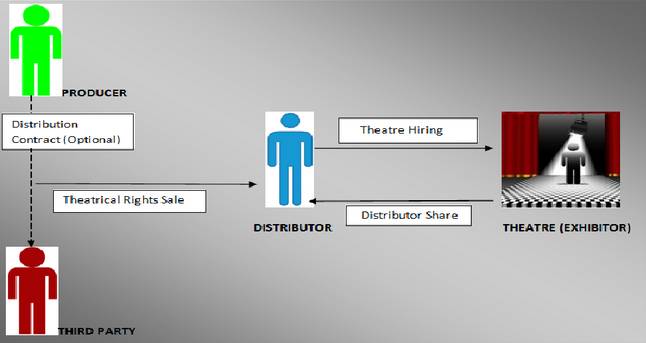
Distributor: The Distributor forms the most vital link in this money chain by acting as a medium between Producers and Theatres. The Producer has to deal out their film to the All India Distributors. The price at which the producer sells his film to the distributors is termed as “Theatrical Rights”. The producer can either directly sell the Theatrical Rights to Distributors or make a contract with any Third Party which in turn has the responsibility to deal with Distributors. In that case the Producer will get his share from the third-party even before his film releases and all Profit/Loss will be incurred by third-party only. For example, Yash Raj Films distribute their films themselves, while Nadiadwala Grandson’s had a contract with EROS for Housefull 2. Indian film industry is majorly distributed in 14 circuits and each have its distributors to represent them :- Mumbai, Delhi/UP, East Punjab, CI (Central India), CP Berar (Central Provinces), Rajasthan, Bihar, West Bengal, Nizam, Mysore, Tamil Nadu, Assam, Orissa and Kerala.
Exhibitor (Theatre): In layman terms, Exhibitor is nothing but a theatre owner. The theatres form the end of the box office model. On pre-defined agreements with the exhibitors, the distributors hire their theatres to showcase films. There are two types of theatres in India: (i) Single Screens (ii) Multiplex Chains and both have different kind of agreements with distributors. This agreement focuses mainly on “Number of Screens” and “Monetary Returns” to be paid back by theatres to Distributors. Entertainment Tax (All India average of 30% approx) is deducted from the total collections at the ticket window. This tax is enforced by individual state governments and thus differs from circuit to circuit. After taxes, a percentage of the total nett gross is paid back to the Distributors. This return is known as “Distributor Share”.
Box Office Model
Box Office Terminology:
  • 1) Cost of Film = [Budget + PA (Promotion & Advertisement) Expenses]
  • 2) Non Theatrical Revenues = Satellite Rights + Music Rights + Overseas subsidy etc.
  • 3) Footfalls = Total number of tickets Sold
  • 4) Gross Collections = Total money collected from ticket sales
  • 5) Net Collections = [Gross collections – Entertainment Tax and others]
  • 6) Distributor Share is generally calculated as below:
 Week 1Week 2Week 3Thereafter
Multiplex50%42%37%30%
Single Screens70-90%70-90%70-90%70-90%

This means 50% of the collections (after entertainment taxes) goes to the Distributor in the first week of release and so on.
  • 7) Profit / Loss (Distributor) = [ Amount at which film was bought – Distributor Share ]
Let us now go through a scenario to better understand about these terms.
Case Study – Suppose a film releases with an average ticket price of Rs 120 at Multiplex and Rs 60 at Single Screens in Week 1. 100 people visit a multiplex and single screen each. Entertainment Tax to be deducted from gross collections is same as 30%.
 MultiplexSingle Screen
Footfall100100
Average Ticket Price12060
Gross Collection100 * 120 = 12000100 * 60 = 6000
Entertainment Tax0.3 * 12000 = 36000.3 * 6000 = 1800
Net Collection12000 – 3600 = 84006000 – 1800 = 4200
Distributor ShareFixed 4200(50% — > 0.5 * 8400 = 4200)Between 2940 and 3780(70% — > 0.7 * 4200 = 2940 /90% — > 0.9 * 4200 = 3780)

Highlights
Multiplex v/s Single Screen: It is quite an inevitable fact that Multiplexes have been dominating the box office with every passing year; still the strength of Single Screens can’t be ignored. Single Screens may be termed as the backbone of Distributor Share for the consistent contribution they make and even today, when it comes to making/breaking big records, a film cannot bypass Single Screens.
Hit vs Flop: General norm is that the collection of a film judges how big success it is. But, this is false. In reality it is the Distributor Share which decides a film’s fate because it takes into account both the film’s cost & its box office performance. A film may be called a FLOP fare if it collects 60cr net because of its huge costs to the makers and distributors. On the contrary, another film may turn out to be HIT even if nets 40cr only due to low budget.
Footfalls – An Untold Story: While writing this article, I realized that there is a parameter which is not quite explored/considered in judging box office numbers. And that is Footfalls – i.e the number of people going to watch a film in theatre. One may figure out quickly from above facts that even if more people visit a Single Screen than a Multiplex, Multiplex always has a lead due to high ticket prices.

Wednesday, April 19, 2017

Production Manager- Role & responsibilities in films/ TV

Production Managers are responsible for all the organisational aspects of production scheduling and budgeting. They work across all genres in television production including documentaries, current affairs, light entertainment or children's programmes, situation comedies, soaps or serial dramas, or one off dramas. 

They assist the Producer to interpret and realise the Director’s vision, financially and logistically. They prepare production schedules or script breakdowns to confirm that sufficient time has been allocated for all aspects of the production process, and to check the Producer’s budget and schedule. 

On drama productions they use special software, such as Movie Magic, to provide logistical breakdowns of scripts, detailing all aspects of production requirements, such as: how many and which actors are needed on which days; what locations are required each day; and crewing requirements.

The Production Manager is the key person in the production department. They report directly to Producers. They work closely with all other heads of department to ensure that productions run smoothly, meet deadlines, and stay within budgets. Throughout shooting, they monitor schedules and budgets, and prepare daily report sheets for Producers, detailing all aspects of each day's shoot.

During pre-production and shooting, they deal with any unexpected circumstances and prepare workable alternative plans. They oversee all aspects of the day-to-day running of shoots, from contract preparation to all Health and Safety requirements, and work closely with members of all other production departments, Actors, and other contributors.

On drama productions, they oversee the 1st Assistant Director’s (1st ADs) preparation of daily call sheets for actors and crew members. They must ensure that all cast and crew members' conditions of work are in compliance with the relevant local agreements and regulations.

Sunday, April 9, 2017

Right to Privacy

Right to Privacy

i) The Press shall not intrude or invade the privacy of an individual, unless outweighed by genuine overriding public interest, not being a prurient or morbid curiosity. So, however, that once a matter becomes a matter of public record, the right to privacy no longer subsists and it becomes a legitimate subject for comment by the Press and the media, among others. Special caution is essential in reports likely to stigmatise women.

Explanation: Things concerning a person's home, family, religion, health,
sexuality, personal life and private affairs are covered by the concept of 12
page12image16136 page12image16296 page12image16456

PRIVACY excepting where any of these impinges upon the public or public interest.


ii) Caution against Identification: While reporting crime involving rape, abduction or kidnap of women/females or sexual assault on children, or raising doubts and questions touching the chastity, personal character and privacy of women, the names, photographs of the victims or other particulars leading to their identity shall not be published.

iii) Minor children and infants who are the offspring of sexual abuse or 'forcible marriage' or illicit sexual union shall not be identified or photographed.


iv) Intrusion through photography into moments of personal grief shall be avoided. However, photography of victims of accidents or natural calamity may be in larger public interest. 

Monday, April 3, 2017

ESSENTIAL SCRIPT ELEMENTS

ESSENTIAL SCRIPT ELEMENTS
Whereas film has no grammar per say, there are certain ‘rules’ of usage in cinematic language and syntax, or systematic arrangement, orders these rules and the relationships between them. This syntax has been determined as a result of the usage of film elements over the years and is not necessarily a determinant of them. Film syntax evolved much like a language. It was an organic development, descriptive rather than prescriptive and constantly changing and evolving. This evolution is still taking place and new thresholds are being pushed by filmmakers everyday. As a basic guide, however, it is important to know these ‘rules’ even if only to break them.
There are three elements of film ‘language’ that should be studied by a script writer and incorporated into a script:
1. Visual Elements
The visual elements of film, or what the audience ‘sees’ on screen is one of the most integral aspects of writing a script. It’s important to understand, firstly, how a film is composed structurally from its smallest component. In a script, this is usually a shot.
The Shot
A shot is a single ‘take’ on an image. It starts and finishes at a ‘cut-point’, which is an editing break in the image. A shot is not defined by any particular image, action or event that takes place on screen. It is more a technical concept. You can have a single shot of a man picking up a paper or two or three of the same thing. It’s basically what occurs between two breaks in editing. In a script, a shot is the smallest visual unit of structure.
Action, Action, Action. You can’t say it often enough!
There is a reason why film is called ‘moving images’. It’s what differentiates it from photographs or painting. Technically, a shot may be a structural unit of film language, but what it contains is more important – action. Shots are made of action. Something needs to be ‘happening’ in a shot for the audience to see – a man walking, a dog barking, a car reversing, a machine working, a river flowing – anything at all that has action, images moving. These actions form events that drive the shot forward to completion.
It’s not enough however, just to have random action on screen. The images, the action, the events have to be meaningful. A documentary, like any film, has limited time in which to convey a multitude of things and to tell a story. Therefore, all the components within the film must be specific and meaningful so as not to waste precious screen time. Each shot has an underlying ‘meaning’ depending on the nature and arrangement of objects and actions within it. This visual way of communication or language has evolved through the years and has three basic elements:
  1. Icon is showing an object or emotion through its likeness – it is what it is and what the audience sees. The signifier represents the signified through similarity to it. For example, a face on screen showing fear is a face showing fear. There are no other meanings, no ‘reading between the lines’. This is the most straightforward approach to a shot.
  2. Index measures a quality not because it is identical to it (like an icon), but because it has a direct and inherent relationship to it. For example, to show heat, or the idea of heat, as a visual, the shot could show a thermometer or heat waves over an empty road or perhaps even a man sweating profusely. This works very well because the scriptwriter can translate an intangible object, like heat, into a tangible and visual reality.
  3. Symbol or Metaphor is an arbitrary sign in which the signifier has neither a direct nor an indexical relationship with the signified, but rather represents it through convention. For example, a rose could be shown to signify love or romance, falling calendar pages could denote time. This technique of using symbols to express ideas and objects has become very popular for its artistic appeal but can and should be used with caution and with a view to the audience’s ability to ‘read between the lines’.
The Sequence
A sequence is a collection of shots put together that tell a story continuously. A sequence is an autonomous piece of the larger story of the film. An entire film is made up of a series of sequences, which can be of varying durations, and are connected to each other in some way. Each sequence has a visual and audio aspect to it.
If a shot is made up of action, a sequence is made up of events. Events mean change in action. These events are built up by the action in the shots to make some sort of sense to the audience and pass along information to them.
Sequences usually fall into one of two categories:
1. A Continuity Sequence is a unit of continuing action which ends in a break in time. This type of sequence is a collection of shots that show an event or events that happened in the same block of time. The end of the sequence occurs when that event is complete and the film moves on to another point in time. The shots within this kind of sequence must be functional, must be logical and must give the illusion of continuity. For example, a continuity sequence could be of a man walking from his house to his office. The sequence starts from when he is outside his front door and the first shot could be of him locking it. After that there could be shots of him walking along the street in his neighbourhood, passing people on the street, going past a children’s park, walking on a pedestrian path with other office goers and, finally, walking into the entrance of his office building. The shots in this sequence would all appear to be in chronological order and continuous.
2. A Compilation Sequence is a unit of information or thought and is sometimes called a ‘newsreel sequence’. There may be many breaks in time during this kind of sequence because the scope is broad. The shots within it could be of events that occurred independently, at different points in time, at different locations and contain different people doing different things. The common aspect that ties all these shots together is conceptual, which is the subject of the sequence. It usually ends when the film’s discussion of the subject ends. For example, the sequence could be about worldwide protests against war and could contain different shots of people from all parts of the globe, some holding banners, some marching hand-in-hand, some giving speeches etc. the sequence would end, when the subject of these protests ended in the film.
A scriptwriter has many choices to make when deciding about the content, treatment and nature of sequences. They can have their own distinct ‘personalities’. A sequence can have a completely autonomous audio-visual and conceptual quality to it. A sequence can be a mere chronological aspect within the film, like a link in a chain, without anything distinct about it. A sequence can be descriptive, where it doesn’t take a stand but just establishes details. Or it can be a strong part of the narrative within the story and contain events that drive the story forward. A sequence can occur in linear time, which is the real time in which events occur, or in non-linear time, when it can cut back and forth between different moments in time.
Documentary sequences, for the most part, are observational. This means that they observe events as they happen. If the film didn’t record the event, it would still take place. For example, a village farmer herding his cattle to graze in the fields is an event that would occur everyday, whether or not there was a sequence that contained it. However, sequences can also be organized. These days, many filmmakers choose to construct or initiate events that can be then included in a sequence. For example, if the film dealt with the issue of the fur trade and how animal rights activists are combating this evil, the filmmaker could organize a rally with a group of activists and use that sequence in the film. The rally would be a real event and the filmmaker’s involvement in organizing it doesn’t affect its authenticity.
  • The Montage
    A montage is a sequence of sorts. It’s a process of combining a number of small shots and weaving them together to communicate a large amount of information in a short time. The shots are usually not strictly continuous in nature nor need they be compiled according to subject. A montage can create a whole new meaning out of the two original meanings of adjacent shots just by coupling them together in a flowing, musical way. This visual technique is often used extensively by filmmakers to cover either broad areas of subject matter or to portray emotion. For example, a documentary may use a montage to portray the past life of an individual character in the film, covering large chunks of childhood, adolescence, young adulthood and middle age, all in a matter of seconds.
  • Talking heads
    One of the most common features of a documentary is talking heads. This includes either interviews of people on camera or people talking directly to the audience on camera or both. Since documentary is non-fiction, the idea of people talking to the camera, or a filmmaker seated behind the camera is an acceptable story-telling/information giving technique. Often these talking heads are experts, people involved in the stories or people who are directly or indirectly related to the subject matter in some form. For example, a film on forest conservation in the Himalayas may have interviews with officials from the government forest dept, with villagers who live in the forests, with conservation experts, people involved with logging and maybe even people protesting against logging.
  • Colours, textures and Lines
    Elements of line, texture and colour all carry their own weights in a film, counteracting, reinforcing, counter pointing and balancing each other within frames in a complex system. These are read by the senses of the audience on a sub-conscious level and are used extensively by filmmakers to add new dimensions in film.
    With the advent of multi-coloured films, a whole new visual world opened up to both the audience, who could now see images as they existed in real life, and for filmmakers, who could experiment that much further with the medium. Colour and its presence or absence from a film can make a significant difference to the film’s message and mood.
    Colour Symbolism is when colour is used deliberately as a symbol on film. Colour speaks and the language of colour, harnessed in a film, is a powerful one. The choice of hues for certain items or its use in out-of-the-ordinary contexts and even the type of lighting used portrays subliminal messages to the audience. A red t-shirt worn by the subject during a sequence may subliminally portray him as a passionate person to the audience. Background colours or the time of day (an orange sunset or an over-exposed, sunny afternoon) have their own symbolism. A dark silhouette of a person walking in an alley may imply he is up to no good.
If a sequence is being organized by the filmmaker, the scriptwriter can have more of a free hand with colour. Demonstrators wearing the colours of a funeral may be protesting the death of democracy; Bright, kitsch clothing may, on the other hand, represent a generation breaking away from tradition. Streets filled with different colours may present a vibrant society, a cultural hub, festivity, growth; the same streets in dull grey or faded colours may present poverty, disease and degeneration.
It is important, however, not to get carried away with colour. That is where Colour Pertinence comes in. There are millions of hues to choose from and vast possibilities when using colour to communicate with the audience. It is easy to get carried away and try and use colour excessively as a medium. Documentaries are about authenticity and the scriptwriter must always remember that subject comes before form. The elements the scriptwriter uses must be in keeping with real events and people. Also, colour can be a powerful element when it is used with discretion and subtlety. Too much colour may give irritate the audience’s senses or may confuse them. Too many colours may lead to the audience overlooking their individual significance or misunderstanding the message.
Textures within a film work on very much the same principles as colour. Texture is important, not only in terms of the inherent texture of the subject but also the texture of the image. Documentary filmmakers often use texture to their advantage by giving old footage a ‘grainy’ texture, thereby signifying that the footage is of real events that happened in the past. A ‘sepia’ texture is often used in recreations/flashbacks for the same purpose. Layering of different shots on top of each other in a half-dissolve has become a popular technique with documentary filmmakers as it creates an almost musical texture.
Lines and form within a frame in a documentary film are also important and can add another dimension. A man walking tall amidst the vertical columns of an old building will immediately be perceived by the audience as someone powerful. The same columns bathed in dark lighting so that only the layers are shown may imply that he has a dark or negative power. In the same way, a man lying in a field of short grass and looking at a flat, striking horizon may be perceived as submissive to the grandeur of nature.
In feature films, these elements are used extensively by filmmakers and they can be applied within real environments by documentary filmmakers as well. Even though, in documentaries, there is sometimes little control over the objects and locations to be shot on camera, the scriptwriter can still incorporate them into the story in many ways by suggesting interesting shots and sequences that are pertinent and relevant to the subject matter. However, this level of detail need not be attempted for every shot and every sequence within the script as documentaries naturally tend to involve less image control. 

RESEARCH, RESEARCH, RESEARCH: YOU CAN’T SAY IT ENOUGH!

RESEARCH, RESEARCH, RESEARCH: YOU CANT SAY IT ENOUGH!

Every film, especially a documentary, has a ‘value’. This could be social, political, historical, philosophical, artistic or of some other kind. The amount of research a scriptwriter puts in is directly related to the ‘value’ of the film.
In the rush to get started, many people often skim over the research process. Especially in films that involve subjects of a personal nature; for example: a person’s journey within his own family to explore social dynamics. A scriptwriter could be instructed to write a script on a live event that was shot some time ago, like a riot, or for a film on the thoughts and feelings of a celebrity already captured in detail on camera. He might ask himself, “How can I possibly add anything more to the subject information?” Even in films that seem straightforward and detailed information has already been given to the scriptwriter, there is always room for more research. There are simply no shortcuts that will provide the quality of a well-researched film.
Suppose a scriptwriter has the footage of a live riot, shot by the filmmaker, along with a detailed log of the events that took place before, during and afterwards, the filmmaker’s personal thoughts about his experience and on-camera interviews with people on both sides about their views. He may think he has enough information to write a fairly comprehensive script and he would be right. However, what if he did a little study on the political, historical and social reasons why that riot may have taken place for some extra context, or if he spoke to a few more people who were involved on that day and who may have seen something he didn’t know about. Perhaps he could visit the riot site, or meet an expert on riots and get his perspective on what happened and even collect the newspaper coverage of that riot and think about the role of media in that event. He could even go so far as to place himself in the middle of a riot (highly unadvisable) to get a first-hand perspective on the experience. In the end, he may or may not use any of the so-called ‘extra’ information he gathered, but his in-depth knowledge on the subject would be extremely valuable in creating an insightful and engaging script.
Curiosity
The best research is done when there is a genuine desire on the part of the scriptwriter to learn more about the subject of his documentary. This is easier said than done, especially when you get that dreaded call about writing a script on the inner components of a diesel generator, but inspiration and curiosity go a long way in helping a scriptwriter. After all, if you’re not excited about it, how on earth are you going to make hundreds, thousands or even millions of people excited? Therefore, the first step in the research process would be to develop a healthy interest and curiosity about the subject of the film. The scriptwriter must ask himself some important questions:
  • What have I not yet been told about this subject?
  • Is everything I have been told the truth? How much do I need to verify?
  • What would I personally like to know about this subject?
  • If I were a member of the audience, what would I want to learn about this subject?
  • What can I find that is little known on this subject?
  • If the shooting has not yet started, what information can I gather that
    would aid the filming process?

    Quantity Vs Quality
    One of the more important questions that scriptwriters have is, “How much research is enough?” The quality of research is far more important than the quantity. After all, if you were a writing a script for a film on the First World War, you could spend a lifetime studying the subject and never meet that script deadline. One of the more important skills of the scriptwriter is to segregate relevant information from the irrelevant. This can be done by having detailed and on-going communication with the filmmaker at all times. The focus of the film and the subject matter it is dealing with must be kept in mind at all times. Any information gathered or lead followed must first be put through a ‘relevancy test’. The scriptwriter must ask himself:
  • Is this information or source of information directly related to the subject of my film?
  • Is it necessary for the audience to know this information?
  • Will this information add to the overall quality of the film?
  • Even if it is relevant and will add value, is it more relevant than all the
    other information I have gathered so far?
  • Will I be able to incorporate this information into the script even if it is
    relevant to the subject?
    The ‘Strategy’
    Almost every scriptwriter starts off with a research strategy. After all, it’s extremely inconvenient to be in the middle of writing a script when a new piece of information crops up. It’s important to think about and list down every approach and every source you will use to gather information needed for research. The all-important question that usually crops up is, “Where do I look?”
    Each scriptwriter has his own sources and approaches for gathering information and many use the same tried and tested ways throughout their careers. A few places to start are:
Print Research :
There are millions of places to look in print: Newspapers, books, magazines, journals, digests, reports, archives, diaries...the list is endless. The scriptwriter must decide which one will be suitable for subject-related information gathering and then physically get hold of the required publication. The usual places to go for finding print material are libraries, bookstores, institutions and organizations with archives and, of course, the internet. Other places could be antique book stores, publishing houses and academic institutions. People also keep print material in their houses and that out-of-print, obscure thesis you were looking for could be lying in your neighbour’s house so it never hurts to ask around.
Unless your film is about something extremely specific, chances are you’ll have a stack of a hundred relevant publications lying in your house waiting to be read. Chances also are you’ll probably not have enough time to read all of them. The art of scouring through large amounts of print material quickly can only be picked up over time, however a novice scriptwriter should try and train his eye to skim over words and stop to read bits of text which occur to him as something he could put in his script or which sounds interesting and should be kept aside. It also helps to keep a look out for ‘keywords’ or words that strike a chord because of their meaning. These words can be used later on in the script, if you are going to write narration. In addition, you may be exploring the idea of including visuals of print material in your film as well, in which case you must select and isolate this material carefully for filming later.
  • Field Research :
    Since film is a visual medium, it is integral that a scriptwriter get an accurate picture of the visual information in the film. He could go to the various locations in which the film will be shot, or to locations where events took place earlier or will take place in the future. The scriptwriter could attend related events or even put himself into places where the people in the film will be or would have been. He could even go to museums, art galleries or any kind of public viewing space where he could gather information. The ‘field’ exists only in relation to the subject of the film and therefore the options are endless and should be visited upon the scriptwriter’s discretion.
    Once the writer reaches a location, it is important to look out for things which might be relevant to the script. You could track events as they happened or look for clues that could reveal facts much like a detective. How to gather field material when on location is subjective to the film, but the scriptwriter must keep a look out for all things visual that can be incorporated as images within the script. The culture of the area should be learnt, the people met, the details noted. Once you gather this knowledge, you must keep it aside for future reference. It also helps when on a shooting location, to note things like where the sunlight comes from at what time and what the sounds are heard around the area. These little details will help you design the script in a more artistic and insightful way.
  • Interview Research :
    Nine times out of ten, a scriptwriter will be called upon to write a script about something he knows nothing about. Factual knowledge can usually be easily attained from print and field research; however the scriptwriter must also gather  perspective. Not one but many. The best way to gain perspective is to speak to people directly and indirectly connected with the subject. Films are a medium for people, by people and therefore a human perspective is imperative for any film. Interview research, which is basically meeting people and asking them questions, is a must for every film.
The scriptwriter must first decide whom to speak to and what to ask them. Normally, the first person or people to seek out are the experts on the subject at hand. They can provide the scriptwriter with not only knowledge but the benefit of their experience. If there are specific events in the film, then the scriptwriter can speak to people who were involved with the events, directly and indirectly. The selection of people should be varied to get different, even opposing, types of information from each. The questions to ask them should cover a range of ideas and should typically include factual and emotional elements as well as opinions and insights. These conversations should be recorded carefully and relevant points should be kept aside. It always helps to listen to any ideas they may have about how you can ‘treat’ the film conceptually, irrespective of whether you incorporate their opinions into the script or not. Who knows? Somebody may give you a gem of an idea.
Inner Worlds & Metaphors :
Every scriptwriter has a different personality, a different perspective. Consequently, every scriptwriter has something unique to contribute to a film. This is often one reason why filmmakers come to a specific writer to write their scripts again and again. Imagination is the biggest talent and tool of the scriptwriter. Although not for everybody, a very effective approach at the research stage can be to look within oneself and gather the benefits of past experiences and try and create an emotional stance on the matter at hand. On a spiritual level, meditating upon the inner world within oneself can be a powerful way of harnessing knowledge locked within the sub-conscious mind and perhaps, if one believes so, the power of the collective unconscious or the cosmos.
Metaphors or parallels exist all around us in our lives. Sometimes, we see something that reminds us of something else or inspires us in a particular way. It could be completely unrelated to the object or concept it invokes a memory of, but still portray it in a meaningful way. You could see a highway ridden with rush hour traffic and be reminded of thousands of ants filing in an out of an anthill carrying food. Or the same sight, with horns blaring and drivers swearing, could make you think about the conquest of a robotic age over humaneness. The possibilities and metaphors around us are endless, just waiting to be picked out by an inventive and imaginative writer.

Digging Deep
Every scriptwriter wants to write a brilliant script and it’s a well known fact that some profound investigation needs to be done for this to be accomplished. So what exactly is digging deep and going beyond the facts? What exactly is the scriptwriter looking for and how can it be defined? There are a few ways of looking at these concerns. Suppose a scriptwriter is researching a film on the migratory killer whales or Orcas off the New Zealand coast. Here is an example of the kinds of research material he might look for:
  • The ‘Top’ of the issue
    The top of the issue includes the facts; killer whales and their appearance, migratory patterns and when they go, where are they spotted, their behavior, their sounds, activities, intelligence. The scriptwriter could delve into scientific research being done on the whales by interviewing two marine researchers, lets call them Ted and Sue, a couple who live and work on the New Zealand coast. The writer could find out the history of the Orcas and the role that humans played in it. Ted and Sue could even take the scriptwriter on a whale observing expedition, where he would experience the whales first hand and also get an idea of what could be shot for the film.
  • The ‘Heart’ of the issue
    The scriptwriter could find out more insightful details about the whales as living creatures and fellow mammals. Do they love, do they hate? Why do they beach themselves all together – is it really collective suicide because they mourn their dead like us humans? What kinds of relationships do they have among each other? Yes, a mother whale is attached to her calf, but are the aunts, the uncles? What do they say to each other when they click and whine? Have Ted and Sue ever come into close contact with any whale? Did they feel a connection? How did the whale react to human contact and was it significant in terms of its emotional value? What did the scriptwriter feel when he looked at a whale for the first time and did he get a sense of the ‘spirit’ of the creature?
  • The ‘Root’ of the issue
    The scriptwriter would find out that the whales have a tragic history because of the excessive whaling that took place in past decades. This tragic and brutal past was because of people, who hunted them almost to extinction. Could their subsequent conservation by people later on be a result of guilt? The scriptwriter could ask what larger role this film could have and the answer might well be to aid in conserving the Orcas for the future by dispelling myths and increasing awareness. This could the message of the film; that everybody needs to get on board to save the killer whale and help them flourish in the oceans.

  • The ‘Branches’ of the issue
    The scriptwriter could try and find related issues that would add value to the film. Does the migration of the whales have any effect on the surrounding ecosystems? How about thinking about the spirit of travel or of the ocean itself? Perhaps talk to a person or a group of people who have saved a beached killer whale in the past. Or go in the opposite direction and talk to a person who has killed a killer whale or eaten one. The possibilities of branching out to explore the issue in greater detail are endless. The scriptwriter should then choose which of the details add value to the film.
  • Finding Challenges
    An issue, when explored in a film, is incomplete when there is nothing introduced that challenges it. The scriptwriter must study the challenges facing the killer whale and their survival as a species. What is being done by people that is hurting their health and causing their numbers to decline, if at all? Are there any challenges put forth by nature that they have to overcome, for instance, like changing temperatures in the waters of the Antarctic? How about large sharks and the threat they pose? Then, the scriptwriter must ask, ‘Is it possible for the killer whales to triumph over these challenges?” and “If they can, then how?” and possibly even, “What can people (i.e. the audience) do to help?”
    Sifting the rice from the chaff: The Post-it Method
    Once you’ve done all there was to do, gathered every bit of relevant information, followed every interesting lead and asked every insightful question, chances are you’ll have more material than you need. At this stage, it’s time to start thinking about which bits of information are going to figure in the film. It’s time to start ruthlessly eliminating material that just doesn’t tell the story. A film lasts for only so long and there are only so many things to be said.
    Organizing research into a comprehensive story basically involves cutting and pasting and seeing which bits of material can follow and ‘flow’ into each other. A good technique is to write down each piece of information in a few words on a post-it or cue card or simply any small piece of paper. For example: one post-it could state “Whales regularly beach themselves in large numbers” and another one could say “Sue looked into the whale’s eyes and cried” etc. Then, stick the post-its in random order on a blank board or wall in columns and rows. After that, the scriptwriter must start a painful process of plucking, discarding and re-sticking until he forms an information chain, which tells the story the writer wants to tell. The only requirement of the story at this stage is that the information must ‘flow’ and all the futile bits of material are discarded. It’s now time to start thinking about writing that script.